

.jpg)
REPOSITORIO DE ACTIVOS DIGITALES
Depósito de documentos digitales reúne, difunde y preserva la documentación generada en los proyectos y actividades del Instituto Andaluz del Patrimonio Histórico.
Por favor, use este identificador para citar o enlazar este ítem:
https://hdl.handle.net/11532/395807
Registro completo de metadatos
| Campo DC | Valor | Lengua/Idioma |
|---|---|---|
| dc.contributor.author | Aranzadi, Isabela de | es_ES |
| dc.date.accessioned | 2026-01-12T21:30:22Z | - |
| dc.date.available | 2026-01-12T21:30:22Z | - |
| dc.date.issued | 2025-09-29 | - |
| dc.identifier.issn | 2340-7565 | es_ES |
| dc.identifier.uri | https://hdl.handle.net/11532/395807 | - |
| dc.description.abstract | The Berlin Conference of 1885 and the partition of Africa in 1900 divided the continent into countries, according to a map drawn up by European powers using a set square and ruler. Many ethnic groups were separated. Some groups in present-day Cameroon, Gabon and Equatorial Guinea, with languages of a common origin, share their history and the links remain in their memory, being transmitted orally. The perception of a common linguistic, sociocultural or spiritual identity is based on the use of objects and expressions, reproducing in each generation its own material culture (musical instruments) and immaterial culture (legends, myths and rituals). The Fang people of Cameroon, Equatorial Guinea and Gabon (Fang, Bulu, Beti, Ntumu, Okak, Mvai...) share musical instruments and dances such as the mendzang me ye kaban with portable xylophones or the ndong mba dance in which the mirliton is used. Idiophone drums (nkuu, asémelé) and membranophones (mbeiñ) accompany almost all musical and ritual expressions. The troubadour mbom mvét is a key figure as a singer of epics. The Ndowe of Equatorial Guinea have close groups in Gabon and Cameroon. The culture shared in myths and legends also involves the use of musical instruments with similar forms and names, such as the double-membranophone ngomo drum and the symbolism of dances such as the ivanga or the mekuio, now performed by groups in Guinea (kombe, benga...) and Gabon (galoa, mpongwe, punu...). We describe some instruments in relation to their ritual, healing and communication functions, the loss of some since colonialism, and the concept of community present in musical expressions. | en |
| dc.description.abstract | La Conferencia de Berlín de 1885 y el reparto de África en 1900 dividieron el continente en países según un mapa trazado a escuadra y cartabón por las potencias europeas. Muchos grupos étnicos fueron separados. Algunas etnias hoy en Camerún, Gabón o Guinea Ecuatorial, con lenguas de tronco común, comparten su historia y los vínculos permanecen en la memoria, siendo transmitidos en la oralidad. La percepción de una identidad común, lingüística, sociocultural o espiritual, se sustenta en el uso de objetos y expresiones, reproduciendo en cada generación la propia cultura material (instrumentos musicales) e inmaterial (leyendas, mitos y rituales). Los fang de Camerún, Guinea Ecuatorial y Gabón (fang, bulu, beti, ntumu, okak, mvai…) comparten instrumentos musicales y danzas como el mendzang me ye kaban con xilófonos portátiles o la danza ndong mba con el mirlitón. Los tambores idiófonos (nkuu, asémelé) y membranófonos (mbeiñ) acompañan casi todas las expresiones musicales y rituales. El trovador mbom mvét es figura clave como cantor de epopeyas. Los ndowe de Guinea Ecuatorial tienen grupos cercanos en Gabón y en Camerún. La cultura compartida en mitos y leyendas supone también el uso de instrumentos musicales forma y nombres similares, como el tambor bimembranófono ngomo y la simbología de danzas como la ivanga o el mekuio hoy en grupos en Guinea (kombe, benga…) y Gabón (galoa, mpongwe, punu...). Describimos algunos instrumentos en relación con sus funciones rituales, curativas y comunicativas, la pérdida de algunos desde el colonialismo y el concepto de comunidad presente en las expresiones musicales. | es_ES |
| dc.format | application/pdf | es_ES |
| dc.language.iso | spa | es_ES |
| dc.publisher | Sevilla : Instituto Andaluz del Patrimonio Histórico | es_ES |
| dc.rights | © Instituto Andaluz del Patrimonio Histórico | es_ES |
| dc.rights.uri | http://creativecommons.org/licenses/by-nc-sa/3.0/deed.es | es_ES |
| dc.source | revista PH, 2025, nº 116, pp. 222-237 | es_ES |
| dc.subject | África | es_ES |
| dc.subject | Camerún | es_ES |
| dc.subject | Danza | es_ES |
| dc.subject | Fang | es_ES |
| dc.subject | Gabón | es_ES |
| dc.subject | Guinea Ecuatorial | es_ES |
| dc.subject | Identidad | es_ES |
| dc.subject | Instrumentos musicales | es_ES |
| dc.subject | Memoria | es_ES |
| dc.subject | Música tradicional | es_ES |
| dc.subject | Ndowe | es_ES |
| dc.title | Instrumentos musicales en Guinea Ecuatorial, Gabón y Camerún | es_ES |
| dc.type | info:eu-repo/semantics/article | es_ES |
| dc.relation.publisherversion | https://www.iaph.es/revistaph/index.php/revistaph/article/view/5929 | es_ES |
| dc.identifier.doi | https://doi.org/10.33349/2025.116.5929 | - |
| Aparece en las colecciones: | Revista PH | |
Ficheros en este ítem:
| Fichero | Descripción | Tamaño | Formato | |
|---|---|---|---|---|
| 5929-instrumentos-musicales-en-guinea-ecuatorial-gabon-y-camerun.pdf | 7,05 MB | Adobe PDF | 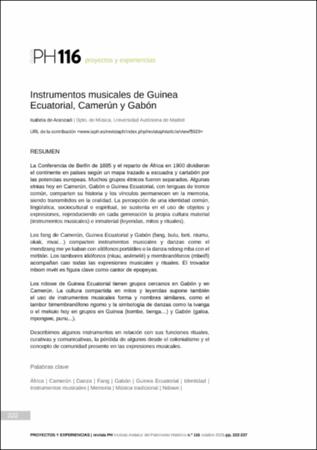 Ver |


Los ítems de IAPH están protegidos por copyright, con todos los derechos reservados, a menos que se indique lo contrario.
Exportar registro


